

Your Reference...is making YOU Irrelevant...
On hoarding versus curation, the archive as alpha, and what Gap and Bastét both just proved about creative conviction.

109 days. No newsletter. Over 300 new subscribers who have no idea what they signed up for.
Quick note: if I’ve bolded something, that’s your sign to go down the rabbit hole.
Imagine a creative brief in 2026 came with one hard rule: no reference.
No moodboards. No screenshots. No inspo folders. Just you, a blank screen, and whatever’s already in your head.
I tried it. And what I discovered wasn’t creative freedom it was a full nervous system audit. Because the moment I closed every tab and sat with nothing, my body started pulling. Not my brain my body. A colour temperature I couldn’t name. A silhouette I couldn’t source. A feeling I’d absorbed from something I watched at 2am in 2014 that I never consciously filed but apparently never lost. My nervous system had been cataloguing reference for decades without asking my permission. Every album cover you loved as a teenager. Every Tumblr-era image burned into your retinas. Every café shot saved “for later,” every meme, campaign, runway show, book cover, half-remembered film scene.
I have severe ADHD. My computer is my internal landscape. I’ve tried more than once to design something “from scratch,” only to realize halfway through I was recreating an old board from memory down to the colour temperature. That wasn’t a lack of originality. That was unacknowledged reference. My body knew the brief before my brain did.
We don’t live without reference. We live inside it.
Every platform has optimized for the save. We have built entire creative industries on top of the collected save moodboards, decks of “visual territories,” folders of screenshots called “Good Fonts 2024.” And somewhere in that process, we started mistaking the act of saving for the act of thinking.
Here’s what’s actually happening when you save something: your nervous system fired before your brain caught up. The dopamine hit of recognition that’s it, that’s the feeling lands in your body a full half-second before you can articulate why. You’re not making a creative decision. You’re having a physiological response. The save is just you trying to hold onto a feeling before it disappears.
Which means your moodboard isn’t a point of view. It’s a record of your nervous system’s reactions to a scroll. I’ve sat in enough creative reviews to know what hoarding looks like dressed up as research: forty-seven references with no argument connecting them. A brand positioning that contains every good word and commits to nothing. A board that says “elevated but also raw, luxurious but also approachable, minimal but also rich.”
That’s not a point of view. That’s a panic response and it looks exactly like what happens when you let your nervous system curate without your brain showing up to edit. The save tells you what caught your eye in a half-second of scrolling. Curation tells you why and more importantly, what you’re building toward. The gap between those two things is where most creative work quietly falls apart.
This is why the best reference isn’t always what excites you immediately. It’s what keeps returning. What you find yourself thinking about three days later. What makes you slightly uncomfortable because you don’t fully understand why you’re drawn to it yet. That discomfort is your nervous system telling you there’s something unresolved something worth sitting with rather than just filing.
Think about Annie Ernaux in Exteriors treating supermarket aisles and RER rides as material to catalogue until they become a living index of a life. Or the way The Face and i-D built entire youth cultures out of street portraits and half-documented nights out. Or how a single Raf Simons show, a Martine Rose presentation, or a Boiler Room thumbnail can silently shift what “underground” looks and sounds like for an entire year.
None of that happened because someone saved a screenshot. It happened because someone sat with a feeling long enough to understand what it meant.
Reference works like that slow, accumulative, atmospheric. It lives in the body before it ever makes it onto a board. It quietly decides which bodies feel “default,” which aesthetics feel “professional,” which rituals stand in for “aspirational life.” It shapes the creative brief before the brief is even written.
You don’t choose whether reference is there. You only choose whether you see it
Case Study 01: Bastét and the Reference That Changes Everything
When I started building the creative direction with Alexandra for Bastét, I knew immediately that the reference had to lead. Not the product. Not the packaging. The feeling we were building toward.
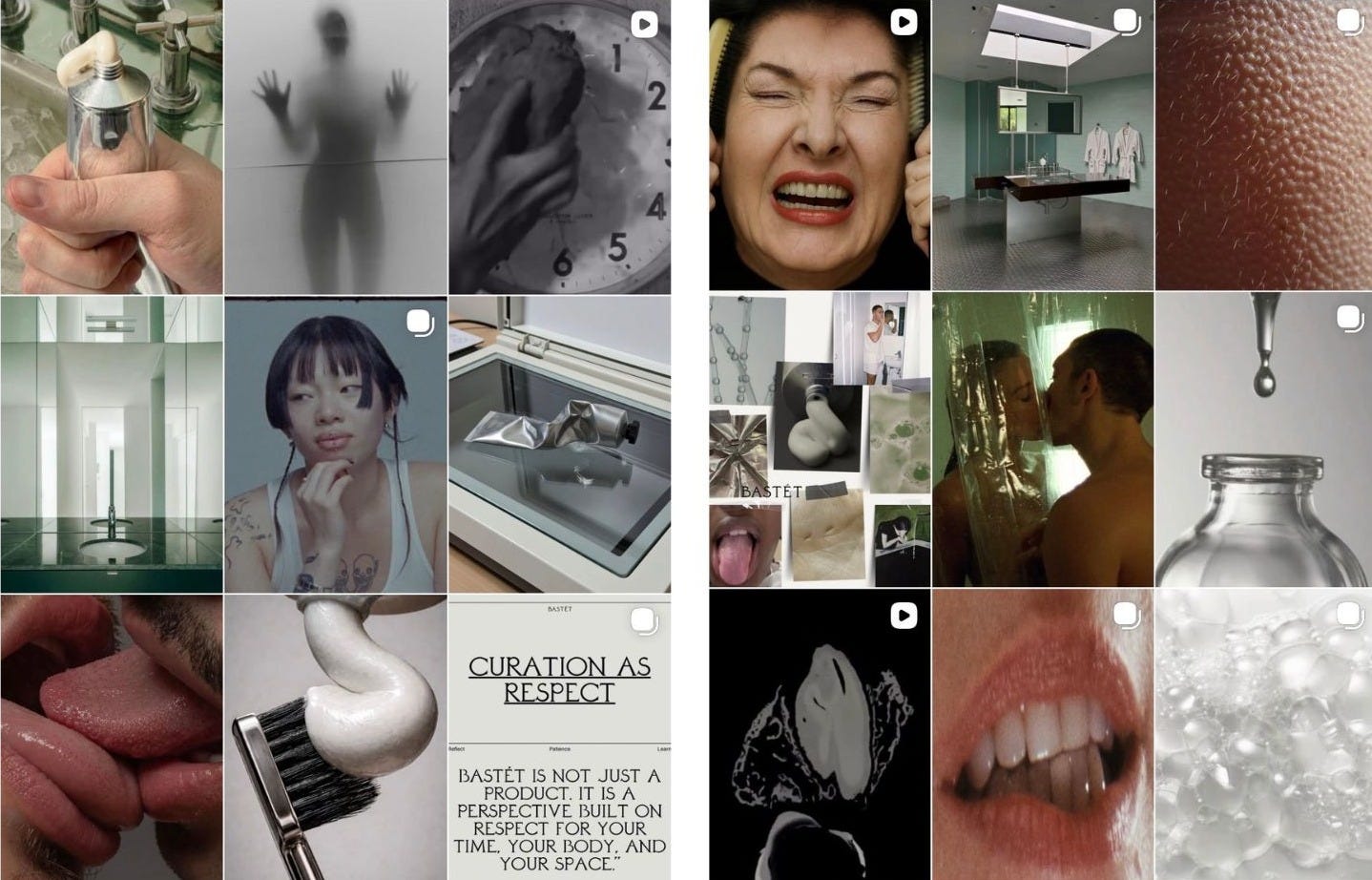
Bastét is used twice a day in the bathroom. The mirror. The routines where so much of modern beauty culture quietly does its damage the space where “perfection” is always just one more product away.
So instead of leading with polish, we chose to lead with perspective.
The reference pool I built doesn’t look anything like oral care. Marina Abramović’s Art Must Be Beautiful (1975) a familiar grooming ritual made confrontational, exposing the emotional weight behind repetitive acts of care. Gaspar Noé’s Irreversible (2002) intimate, bodily, shot like memory itself, where the bathroom isn’t a place of polish but of raw presence. On The Art of Teeth at Barts Pathology Museum science and imagination colliding around the most personal part of the body, where memory and loss live inside something as small as a tooth. Donald Wexler’s Dinah Shore Estate, Palm Springs, 1964 the bathroom as architecture, as intention, as a space designed to make you feel something before the day begins.
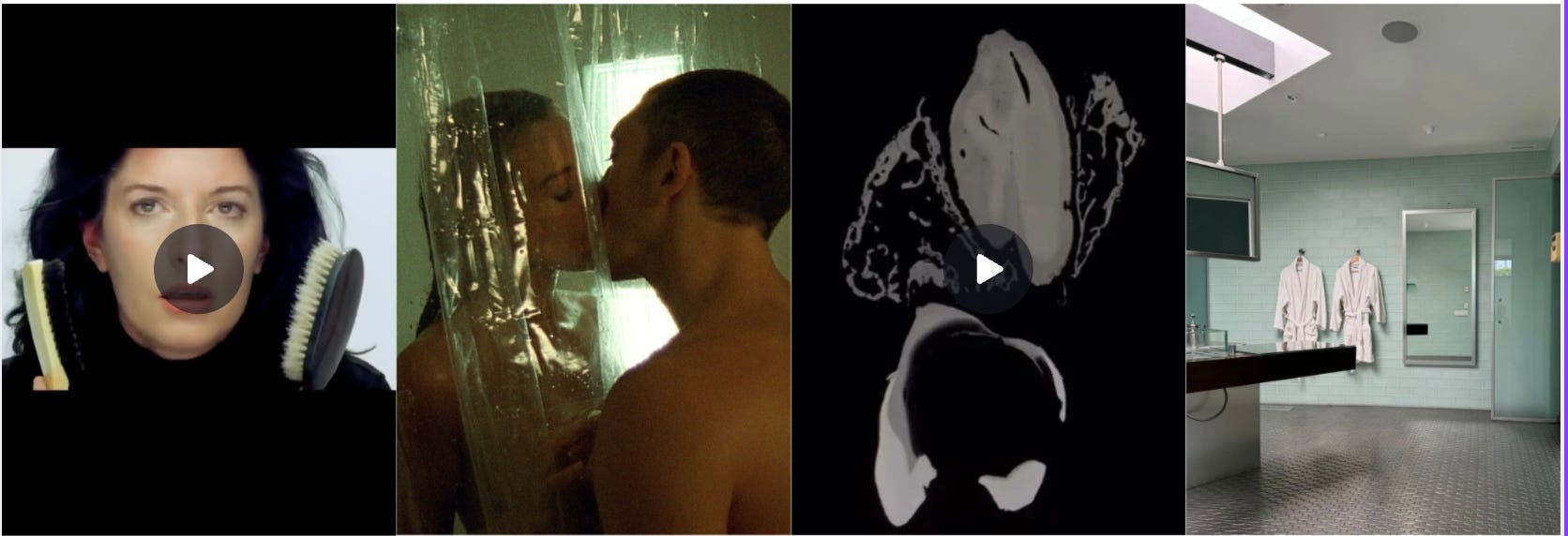
None of these say “oral care.” All of them say this is what it feels like to inhabit your body honestly. That lens changed the brief entirely. It gave us permission to frame Bastét not as a product you use, but as a world you inhabit. A space where daily rituals aren’t about chasing perfection they’re about presence, intention, and a more honest relationship with yourself.
One reference pool. Performance art, arthouse cinema, pathology, and mid-century architecture. Applied to toothpaste. That’s what curation looks like when it’s working not a mood board full of “clean girl aesthetic” screenshots, but a constellation of specific ideas that reframe everything they touch.
Because Bastét isn’t just something you use. It’s something you feel. Twice a day. Every day. @bastetritual
Case Study 02: Gap and the Archive as Alpha
I have a feeling we’re about to see 1999 numbers. And I mean that literally.
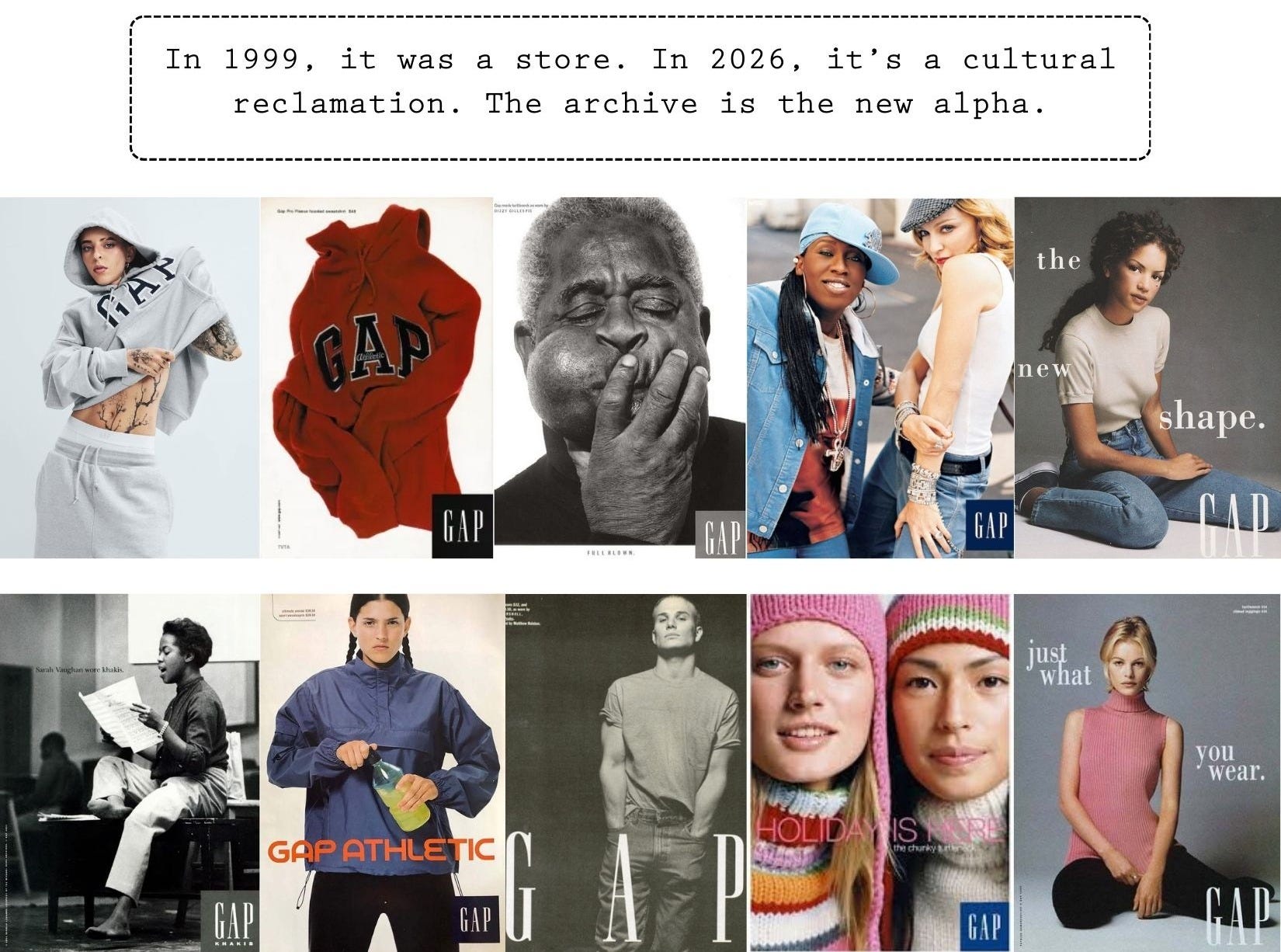
I’m officially invested in Gap.
Yesterday morning, I put some $$$ in and I have a feeling we are going to see 1999 numbers very soon. The turnaround we’re witnessing isn't just about sales. It’s about relevance. Looking at the recent Fall/Winter campaigns and the "Sweats Like This" launch with Young Miko, Gap has rediscovered the "Modern Antiquity" of its own archive.
In 1999, Gap was the cultural default the "Modern American Uniform." By blurring the lines between mass-market utility and luxury-tier storytelling (that Met Gala denim gown was a massive signal), they are capturing a cross-generational audience in a way we haven’t seen in 25 years. They’ve stopped chasing fast-fashion trends and started world-building again. When a brand finds the intersection of archive soul and modern demand, the financials follow. The most recent data already shows a 7% growth in comparable sales. The exact same momentum they had during the 1999 peak. I’m telling ya, the archive is the new alpha. Get your wallets ready.
(Disclosure: not financial advice.)
When a brand’s reference field gets too small, they fall into what I call Aesthetic Incest recycling the same five boards as their competitors. This isn’t just a creative failure. It’s a market failure. You cannot command a premium price if you look exactly like the algorithm’s default settings.
The brands that feel flat right now expensive but hollow have mastered the save and skipped the argument. Beautiful imagery. Considered palette. Correct typography. No position underneath any of it. No cultural lineage. No point of view that would survive contact with anything outside their own reference bubble.
I call this Aesthetic Fluency Without Aesthetic Conviction. The creative equivalent of speaking a language perfectly without having anything to say.
The fantasy of “no reference” comes from fear of influence and shame about dependence. But we are porous by design. We learn to see by copying. We learn to make by imitating, then misremembering, then mutating. Living with too little reference is the real nightmare.
What To Actually Do About It
Real curation is an act of elimination. It’s not about what you love it’s about what you can defend. What connects. What builds toward something instead of just existing beside everything else.
So: notice the reference you’ve already absorbed. Expand your perimeter. Go deep on the lineage of your ideas. Get off your computer. Pull in something that “doesn’t belong” a Rei Kawakubo silhouette from 1982, a Xerox PARC interface prototype, a zine from a 90s rave culture collective.
And if you don’t know where to start, Kel Rakowski ’s Popular newsletter just put out 64 places to find image reference that isn’t your typical digital archives, museum collections, subculture ephemera, propaganda posters, matchbox labels. It’s the most useful resource I’ve seen in months. Go read it.
And for everything in your board right now ask not what do I like about this but what is this evidence of? A proportion you keep returning to. A typographic logic that keeps showing up. A subculture moment that shifted everything downstream without getting credit for it. If you can’t answer that in a sentence, it’s a save, not a reference. File it or lose it.
The goal isn’t a smaller board. The goal is a board with a spine something someone else could look at and immediately know what you’re building, and why, and what comes next.
That’s the difference between an internet researcher and an internet user.
Sheeeshhh this was a long one. See you next week.
Love this. I used to work with Zac Posen when he was building his own brand. He is such a creative genius. I love watching him work his magic at Gap.
Wow loved this!